Showing posts with label dystopian future. Show all posts

Thursday, 26 March 2026

SCI-FI FILM FIESTA FREE EBOOK: The Swingin' 60s Volume 3 - "Freaky Future Shocks"


SCI-FI FILM FIESTA FREE EBOOK:
The Swingin' 60s
Volume 3 - "Freaky Future Shocks"


From the eerie time paradoxes of Beyond the Time Barrier (1960) and the haunting evolutionary warnings of The Time Machine (1960), to the dangerous pursuit of knowledge in The Man with the X-Ray Eyes (1963), this volume explores the consequences of pushing beyond the limits of understanding. The journey continues through the chilling dystopia of Fahrenheit 451 (1966), the iconic cautionary tale of Planet of the Apes (1968), and the psychological unease of The Power (1968).

Rich in detail, insight, and atmosphere, Volume 3 of Sci-Fi Film Fiesta, The Swingin’ 60s - “Freaky Future Shocks” captures the anxieties of a world caught between optimism and dread—where every scientific breakthrough carried the possibility of unintended and irreversible consequences.

The films explored in this volume may belong to another era, but the questions they raise remain as relevant as ever. Each reflects a world grappling with change—scientific, social, and existential—and each offers a glimpse of futures shaped as much by human choices as by technological possibility.

In revisiting these stories, we are reminded that the future is not a fixed destination, but something continually being created. The warnings, hopes, and imaginings of the past still speak to us—if we are willing to listen.

More than a celebration of classic cinema, this volume is an invitation to reflect on our own time. As we navigate an age of rapid technological change, the visions of the 1960s feel less like distant fantasies—and more like warnings we are only just beginning to understand.


The future is coming!
The question is…
are we ready for it?

Oh, did I mention that this volume is…….

FREE!!!!


EPUB DOWNLOAD 


PDF DOWNLOAD


KINDLE DOWNLOAD


MOBI DOWNLOAD


TXT DOWNLOAD


And now available on GOOGLE PLAY BOOKS


Saturday, 16 November 2024

Beyond the Time Barrier (1960)


Although a low-budget film, it is quite entertaining and engaging which is a tribute to the director and the able performances of the cast.


Directed by Edgar G. Ulmer
Screenplay by Arthur C. Pierce
Produced by Robert Clarke
Cinematography: Meredith M. Nicholson
Edited by Jack Ruggiero
Music by Darrell Calker
Distributed by American International Pictures
Running time: 75 minutes
Budget: $125,000


Cast


Robert Clarke as Maj. William Allison
Darlene Tompkins as Princess Trirene
Arianne Arden as Capt. Markova
Vladimir Sokoloff as The Supreme
Stephen Bekassy as Gen. Karl Kruse
John van Dreelen as Dr. Bourman
Red Morgan as Captain
Ken Knox as Col. Marty Martin
Don Flournoy as Mutant
Tom Ravick as Mutant
Neil Fletcher as Air Force Chief
Jack Herman as Dr. Richman
William Shapard as Gen. York
James Altgens as Secretary Lloyd Patterson
John Loughney as Gen. Lamont
Russell Marker as Col. Curtis


Trailer

Report on March 5th 1960 ncident involving lead test pilot, US Air Force Major Bill Allison.

Sands Airbase Intelligence Division

Location: Sands Air Force Base

Context: X-80 high altitude flight preparation for space program.

Contents:

  • Transcript of initial de-brief interrogation
  • Transcript of tape recording by Major Allison recounting his experiences from time of test flight commencement until his return in the X-80.
Summary:
(based on Maj Ellison’s testimony)


  • Upon his first landing at Sands airfield after the high altitude test, Maj Allison found the base and its surrounds to be totally desolate and devoid of any life.
  • Allison had come to believe that he had broken the time barrier and had arrived in the future in the year 2024.
  • Maj Allison went on to discover a subterranean world called the Citadel.
  • He also learned that a plague occurred due to nuclear fallout not long after our own era.
  • With the exception of two prominent citizens of the Citadel, one being designated The Supreme and the other, The Captain, everyone else, as a result of the plague was deaf, mute and sterile.
  • The Supreme's granddaughter, named Princess Trirene, may not have been afflicted by sterility and had according to the major the ability to read minds.
  • Allison claimed that three others in the Citadel had also like him found their way into the future, having arrived from different post-plague years.
  • The major also reported that those in authority suspected hum of being a spy and and were determined to keep him there in order to procreate with the Supreme’s grand-daughter due to the sterility problem and the threat to their populations’ survival.
  • Maj Allison made it his mission to return to 1960, in order to attempt to prevent the plague from occurring by convincing those in authority the truth of what he experienced.
  • Maj. Allison managed to return to Sands Airbase but with significant and inexplicable physical consequences to himself, in addition to possible emotional and psychological effects that could have a bearing on the validity of his account, the transcript of which along with the original recording are contained with this report.


Read on for more…….

Friday, 18 February 2022

THX 1138 (1971)

A somewhat slow-paced, thought-provoking, atmospheric and artistic ground-breaking dystopian sci-fi film


Directed by George Lucas
Screenplay by George Lucas, Walter Murch
Story by George Lucas
Based on "Electronic Labyrinth: THX 1138 4EB" by George Lucas
Produced by Lawrence Sturhahn
Cinematography: David Myers, Albert Kihn
Edited by George Lucas
Music by Lalo Schifrin
Production company: American Zoetrope
Distributed by Warner Bros.
Running time: 86 minutes
Budget: $777,777
Box office: $2.4 million


Cast


Robert Duvall as THX 1138
Donald Pleasence as SEN 5241
Maggie McOmie as LUH 3417
Don Pedro Colley as the hologram actor SRT 5752
Ian Wolfe as the old prisoner PTO
Marshall Efron as prisoner TWA
Sid Haig as prisoner NCH
John Pearce as prisoner DWY
James Wheaton as the voice of OMM 0000

A dystopian future in which people are controlled through the use of android police and mandated use of drugs to suppress emotions.

A uniform and homogeneous world that suppresses
individuality and love.

A sterile bleak future where unquestioning conformity is the rule.

THX 1138 is a citizen of that future society living the reality imposed by the State until the time arrives when his perception of that reality begins to change.


Trailer


Read on for more.....

Tuesday, 21 December 2021

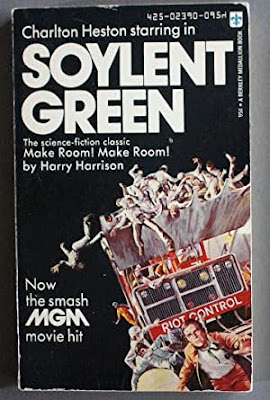
Soylent Green (1973)


An intelligent and engaging sci-fi detective story with a disturbing vision of the future.


Directed by Richard Fleischer
Screenplay by Stanley R. Greenberg
Based on “Make Room! Make Room!” by Harry Harrison
Produced by Walter Seltzer, Russell Thacher
Cinematography: Richard H. Kline
Edited by Samuel E. Beetley
Music by Fred Myrow
Distributed by Metro-Goldwyn-Mayer
Running time: 97 minutes
Box office: $3.6 million


Cast


Charlton Heston as Thorn
Leigh Taylor-Young as Shirl
Chuck Connors as Fielding
Joseph Cotten as Simonson
Brock Peters as Hatcher
Paula Kelly as Martha
Edward G. Robinson as Sol Roth
Stephen Young as Gilbert
Mike Henry as Kulozik
Lincoln Kilpatrick as The Priest
Roy Jenson as Donovan
Leonard Stone as Charles
Whit Bissell as Santini
Celia Lovsky as the Exchange Leader
Dick Van Patten as Usher #1


Trailer


• 2022 AD: A dystopian future world beset by climate catastrophe in the form of dying oceans; year-round greenhouse-caused heat and humidity; air, land and sea pollution; poverty; overpopulation and depleted resources.

• Population of New York City: 40.000.000

• Only the elite can afford spacious apartments, clean water and natural food at exorbitantly high prices. Their homes are gated and fortressed and they are provided with private security, bodyguards and slave / concubines referred to as "furniture."

• The bulk of the population has to contend with shortages of food, water and housing.

• NYPD detective Frank Thorn is tasked with investigating the murder of the wealthy and influential William R. Simonson, a board member of the Soylent Corporation.

• What is eventually uncovered could be more than Thorn or anyone else had bargained for…..


Read on for more......

Wednesday, 28 April 2021

Francois Truffaut’s, Fahrenheit 451 (1966) - Part 2


Commentary


(Some spoilers below...)


Background & Production

Truffaut’s film is based on Ray Bradbury's famous novel, Fahrenheit 451. It was Truffaut's first color film and his only non French-language film. At the 1966 Venice Film Festival, Fahrenheit 451 was nominated for the Golden Lion.


In a detailed diary Truffaut kept during the production, he referred to Fahrenheit 451 as being his "saddest and most difficult" film-making experience, mainly because of intense conflicts between Werner and himself, about which much has been made by others. For instance, Oskar Werner supposedly cut his hair for the final scene to create a continuity error, being motivated by his hatred for the director. For the last two weeks, both men reportedly didn't speak to one another. Still, what work place doesn’t have conflict and difficult interpersonal relationships? Not all films that have cast and crew holding hands and singing Kumbaya turn out to be masterpieces. It’s the end result that counts and in the case of Truffaut’s film, it’s a pretty good result.


Julie Christie was originally cast as just Linda Montag, with the part of Clarisse being offered to Jean Seberg and Jane Fonda, with even Tippi Hedren being considered. Truffaut ultimately decided that Christie be cast in both roles as two sides of the same coin so to speak. Julie Christie agreed to star in this film for $200,000, while her asking price at the time was $400,000.

The film was shot at Pinewood Studios in England. The monorail exterior scene was taken at the French SAFEGE test track in Châteauneuf-sur-Loire near Orléans, France. It was dismantled shortly after filming. The film featured the Alton housing estate in Roehampton, south London, and Edgcumbe Park in Crowthorne, Berkshire. The final "Book People" book reciting scene was filmed at Black Park near Pinewood. It was hoped the weather would improve for the final days of shooting. Instead, it had begun snowing during the night. The presence of snow in the final shots was unexpected and unplanned but proved to be effective.

The production work was done in French, as Truffaut spoke virtually no English but co-wrote the screenplay with Jean-Louis Richard.

The movie's opening credits are spoken rather than displayed in type, which suggests what life would be like in a society in which the printed word is banned.


Truffaut’s “Fahrenheit 451” doesn’t offer us a sleek whiz-bang typical sci-fi 'futuristic' view of the future. Unlike Bradbury’s book, there is no deadly mechanical hound. Bradbury wasn’t focused on anticipating the possible great technological advancements of the future. Instead of such details, he would focus on presenting “what if?” scenarios and considering implications and consequences for humanity. What we do have though in the film version are commuters traveling via monorail and living rooms with wall screens uncannily resembling our own 21st century HDTV sets. The houses are uniform ‘60s style modernist functional but soulless structures that seem to contain retro gadgets like the wall phones. Even the red fire engines look like dinky Tonka toys rather than massive high-tech futuristic beasts. Such elements seem to suggest to the viewer that we are dealing with a world that is not too far removed from our own experience.


Read on for more....