Showing posts with label tribute. Show all posts

Friday, 3 March 2023

Sci-Fi Film Fiesta - Volume 11: 'A Tribute To.....' Final Volume in the eBook series


This 11th volume “A Tribute To….” of the Sci-Fi Film Fiesta series is dedicated to the actors, directors, producers, special effects artists, writers and other involved in the pioneering work of science fiction movie making.

Part 1: A Tribute To…. focuses on some of the prominent directors, producers, actors and special effects people involved in science fiction films of the 1950s. Brief biographical information is provided on each one, along with their contribution to the pioneering work of sci-fi film-making in the 1950s.

Part 2: A Tribute To Classic Sci-Fi Ladies provides a brief introduction to each of the female co-stars and supporting actors in the films featured in the Sci-Fi Film Fiesta eBook series.

Part 3: A Tribute To Science Fiction Authors references some of the works of fiction that inspired and were adapted into various classic 1950s sci-fi films.


CONTENTS

Introduction

***Part 1: A Tribute To….

Ray Harryhausen
George Pal
Roger Corman
Richard Carlson
Jack Arnold
Richard Denning
Faith Domergue
Hugh Marlowe
Whit Bissell
Morris Ankrum
Ishirō Honda
Russell Johnson
John Zaremba
Peter Graves
Beverly Garland
Paul Birch
Peggie Castle
Paul Blaisdell
Val Guest
Willis O'Brien
John Agar
Bert I. Gordon
Eugène Lourié
Warren Stevens
Yumi Shirakawa
Robert Wise

***Part 2: A Tribute to…..Classic Sci-Fi Ladies

***Part 3: A Tribute To…..Science Fiction Authors
(& The Inspiration They Provided)

John W. Campbell Jnr
Paul W. Fairman
W. J. Stuart
Harry Bates
Raymond F. Jones
Philip Wylie and Edwin Balmer
John Wyndham
Jack Finney
William F. Temple
H.G. Wells
John Mantley
Curt Siodmak

I hope you'll enjoy this final volume of the Sci-Fi Film Fiesta eBook series along with the other volumes. My original intention in writing about classic science fiction films of the 1950s was to present it in the form of a book but I instead chose to do so via this blog. Having completed featuring sci-fi films of the 1950s and moving on to films of the 1960s through to the 1980s, I decided to go back to my original idea. With the amount of information such a book would encompass, I then decided to present it in a freely available eBook format consisting of 11 manageable volumes devoted to various general themes for easy reference.


The Complete Sci-Fi Film Fiesta series:

Volume 1: “Here Be Monsters”
Volume 2: “Into Space”
Volume 3: “Other Worlds”
Volume 4: “Journeys Within”
Volume 5: “Alien Contact”
Volume 6: “Alien Invasion”
Volume 7: “The End Is Nigh!”
Volume 8: “Big Bugs & Crazy Critters”
Volume 9: “Accidents & Experiments”
Volume 10: “Supersized & Miniaturized”
Volume 11: “A Tribute To….”


Also available at....


FREE EBOOKS.NET

Wednesday, 20 March 2019

A Tribute to Warren Stevens


Screen Sci-Fi Stalwart - 
That & Much More!

Warren Stevens is the actor with the familiar face we have seen in many films such as the sci-fi classic, Forbidden Planet (1956) and the 1954 film, The Barefoot Contessa in which he appeared with Humphrey Bogart, Ava Gardner and Edmond O'Brien. Let’s also not forget the numerous TV series Warren Stevens appeared in such as the original Star Trek.


Warren Stevens was born Warren Albert Stevens on November 2, 1919 in Clark’s Summit, Penn., He attended the Naval Academy but due to vision problems he left before graduating. He did later manage to serve as a pilot in the U.S. Army Air Corps during WWII.

After WWII he worked in radio and joined the Actors Studio in New York. He was then offered a Hollywood contract at 20th Century Fox and made his Broadway debut in The Life of Galileo (1947).

As a contract player, Stevens had little control over the roles he played.

His first movie role was in The Frogmen (1951), starring Richard Widmark and Dana Andrews, followed by other roles including Phone Call from a Stranger (1952), Wait Till the Sun Shines, Nellie (1952).

In 1952 Stevens appeared in seven films, including the Deadline — U.S.A. (starring Humphrey Bogart) in which Stevens had a significant supporting role as a reporter.


In 1956 Stevens was given a very solid role in the classic sci-fi masterpiece, Forbidden Planet (1956) in which he played the part of Lt., "Doc" Ostrow.

His other sci-fi movie appearances included, On the Threshold of Space (1956) as Capt. Mike Bentley and as Dr. Carl Zellar in Cyborg 2087 (1966), starring Michael Rennie. 


Warren Stevens went on to have occasional supporting roles in big films but was unable to achieve a real breakthrough in his career with A-list movies. The direction of his acting career thereafter shifted to television as a journeyman dramatic actor.

Stevens appeared in over 150 prime time shows from the 1950s to the early 1980s, including: Tales of the 77th Bengal Lancers (as Lt. William Storm), Actors Studio, Campbell Playhouse, Studio One, Route 66, Hawaiian Eye, Perry Mason, The Untouchables, Climax!, Surfside 6, 77 Sunset Strip, I Spy, The Man from U.N.C.L.E., Ironside, The Mod Squad, Mannix, Cannon and Mission: Impossible.

Stevens also appeared in episodes of some classic Western series such as, Laramie, Wagon Train, Gunsmoke, Bonanza, Daniel Boone, The Virginian and Rawhide.


Fans of film and TV sci-fi / horror will definitely appreciate Warren Stevens contribution to the genre with appearances in Alfred Hitchcock Presents, The Twilight Zone ("Dead Man's Shoes"), One Step Beyond ("The Riddle”), The Outer Limits ("Keeper of the Purple Twilight"), Star Trek ("By Any Other Name"), Voyage to the Bottom of the Sea, The Time Tunnel, Science Fiction Theater, and Land of the Giants.


Warren Stevens died in Sherman Oaks, Calif., of respiratory failure on Tuesday, March 27, 2012. He was 92. He had three sons and was married to Barbara Fletcher Stevens for 43 years.


©Chris Christopoulos 2019

Friday, 22 February 2019

Father of Science Fiction & Fantasy - Oscar Winner George Pal Interview Preservation - GoFundMe


George Pal was as you may know is known as The Father of Science Fiction and Fantasy in Modern Film. In the annals of Hollywood, Academy Award winner George Pal will always be remembered as a titan, a brilliant visionary who profoundly shaped the art of motion pictures. As an animator, Pal was a pioneer of stop-motion animation known as Puppetoons ™ and a peer of Walt Disney. In the 1950's as a producer and director of live-action films, he brought to the screen such science fiction and fantasy classics as "The War of the Worlds", "The Time Machine", "When Worlds Collide", "Destination Moon", "Tom Thumb", "Houdini", "Atlantis the Lost Continent" "The Wonderful World of the Brothers Grimm", "7 Faces of Dr. Lao", "The Power", "Doc Savage: Man of Bronze" and others. Pal's cinematic legacy can be traced in the works of Walt Disney, George Lucas, Steven Spielberg, Gene Roddenberry, Tim Burton, James Cameron, Peter Jackson and dozens of others.

Link to George Pal Tribute on this blog: 


The original 1 inch 'B' NTSC video format used in the production of The Fantasy Film Worlds of George Pal - the only film document ever done on Pal - are long out of use. To make matters worse, only 2 working 'B' NTSC 1 inch videotape machines exist that can aid in the digitization process. There is no telling how long these machines will last or their working parts as they are no longer in existence! 


It goes without saying, this is a severe race against time to preserve what represents the only film document ever made on George Pal and the beloved one of a kind icons that worked with him.... most of whom have sadly passed on.

The historical importance of preserving and digitizing these interviews cannot be understated!

Talent interviews to preserve includes: Rod Taylor, Alan Young, Tony Randall, Tony Curtis, Ray Harryhausen, Ray Bradbury, Gene Roddenberry, Charlton Heston, Janet Leigh, Russ Tamblyn, Barbara Eden, Ann Robinson, Roy E. Disney, Ward Kimball, Robert Wise, George Pal, Mrs. George Pal, David Pal, Gae Griffith, Walter Lantz, Gene Warren Sr., Wah Chang, Jim Danforth, Robert Bloch, Chesley Bonestell, Albert Nozaki, William Tuttle, Duke Goldstone, Bob Baker and Phil Kellison.

The digitizations will be used to upgrade existing productions. Eventually they will be find a home with film footage companies and possibly donated to an educational institution yet to be determined.

If you’d like to help with preserving these irreplaceable interviews about one of the most influential figures in the history of motion pictures and the science fiction/fantasy genre, please use the Link Below:


https://www.gofundme.com/fantasy-worlds-of-george-pal-film-preservation


Wednesday, 26 December 2018

A Tribute to Marshall Thompson


(November 27, 1925 – May 18, 1992) 


Avid photographer, horseman, guitarist and film and television actor: a true multi-talented individual 


American film and television actor, Marshall Thompson was born James Marshall Thompson in Peoria, Illinois. He was an only child and was named James Marshall Thompson after an ancestor, a famed Supreme Court justice. At the age of five, he and his parents, Dr. and Mrs. Laurence B. Thompson, moved to California.

His father set up a successful Westwood dentistry practice. His mother even once took to the stage as a concert singer and musician. Marshall was their only child.

Thompson enrolled at Occidental College intending to become a dentist.

While in high school, Thompson appeared in a number of school productions and was spotted by a local talent agent, but this didn’t lead anywhere. At University High School he was a classmate of Norma Jean Baker, who we know by the name of Marilyn Monroe.

As far as acting went, Marshall Thompson was “re-discovered” while performing as one of the Occidental Players. 


In 1943, Thompson was signed up by Universal Pictures where he went on to play quiet, thoughtful teen roles in feature films. He even scored a lead role playing opposite singing star Gloria Jean in Reckless Age for which he earned $350 per week.

In 1946 after being discharged from Universal, Thompson moved to MGM and had more frequent and superior roles in films such as The Clock and the lead in Gallant Bess, MGM's first Cinecolor film.

While with MGM, Marshall Thompson also appeared films such as Blonde Fever (1944), They Were Expendable (1945) and Bad Bascomb (1946). In addition, there were the war dramas, Homecoming (1948), Command Decision (1948) and Battleground (1949). In Dial 1119 (1950) he appeared as a cold-hearted, baby-faced killer, and wound up his MGM contract with The Tall Target (1951) in which he played a potential assassin of Abraham Lincoln.

In the 1950s, Marshall Thompson became a freelance actor working for various studios. It was during this period that he appeared in science fiction films and TV series. 


From 1955-6, Thompson appeared in seven episodes of “Science Fiction Theatre” on TV. The episodes include;

The Human Circuit: A nightclub dancer claims that she saw a nuclear blast during a seizure she suffered. It seems she had witnessed a top-secret bomb explosion in the Pacific. How to explain her clairvoyant talent scientifically?

Three Minute Mile: Dr. Kendall’s assistant, college student Britt has somehow acquired incredible strength and speed. Is this the result of experiments the doctor is conducting?

The Human Experiment: An enzyme from bees intended to help the mentally ill function in society has had some strange effects on a house full of patients.

Bullet Proof: A bank robber uses a piece of metal salvaged from an alien spacecraft to aid his thefts.

Target: Hurricane: A killer storm mysteriously appears offshore.

The Frozen Sound: Government agents attempt to rescue a kidnapped research scientist.

Stranger In The Desert: Two uranium prospectors locate a rich deposit along with a botanist who seems to have a strange motive. 


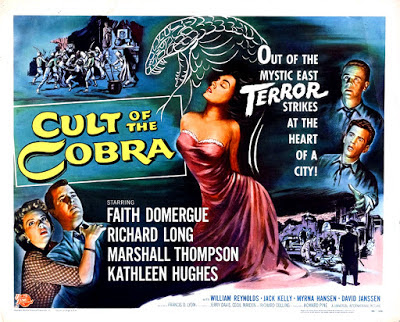
In 1955 Marshall Thompson starred with Faith Domergue, in Universal's Cult of the Cobra in which American G.I.s trespass on a Hindu ceremony and are hunted down by a beautiful woman who has the power to transform herself into a cobra! Thompson also appeared in this film with his brother-in-law, Richard Long. 


trailer


In 1958 Thompson starred in the sci-fi thriller, Fiend Without a Face in which a scientist experiments with telekinetic powers that are enhanced by a nearby nuclear power plant and succeeds in creating a new form of life. This new creature manages to escape his laboratory and multiplies the closer it gets to its nuclear power source. 


trailer


In It! The Terror from Beyond Space (1958), Thompson plays Colonel Carruthers, the sole survivor of the first mission to Mars who is falsely accused of killing his fellow crew members on Mars. Carruthers claims that his crew were killed by a hostile Martian life form. While returning to Earth, the real monster behind the murders has stowed away aboard the rescue ship and begins hunting the crew as they return to Earth! The film's premise would inspire the plot for director Ridley Scott's sci-fi film, Alien (1979).


trailer

Then in 1959, Thompson starred as Commander Prescott in the sci-fi / horror film, First Man into Space in which his character’s brother, hotshot Navy test pilot, Dan Prescott takes the new rocket powered Y-13 plane up on its maiden test flight. Once he reaches the upper atmosphere, Dan disobeys orders and takes the plane further up into space where he encounters a strange cloud of meteor dust with terrible consequences for himself and many others.

Thompson also starred in the 1959 13-episodes syndicated science fiction TV series World of Giants in which the character Mel Hunter, a U. S. counter-espionage agent, is accidentally miniaturized to just six inches in height.

Apart from his appearances at that time in sci-fi and horror B-movies, Marshall Thompson had a couple of notable roles in To Hell and Back (1955) and East of Kilimanjaro (1957), in which he performed his own dangerous stunts and developed a lifelong passion for Africa and wildlife.

In 1960, Thompson guest starred as Arthur Poe in the Perry Mason episode "The Case of the Wayward Wife.". He also co-starred with the Belgian-born Annie Fargé in the 33-episode CBS sitcom Angel and later went on to star in two Vietnam War films: A Yank in Viet-Nam (1964) (directed by Thompson) and To the Shores of Hell (1965). 


In 1965 he returned to MGM to play the lead for which he is probably best remembered in the film Clarence, the Cross-Eyed Lion (1965). Thomson played the character, Dr. Marsh Tracy, a veterinarian and single father, raising his daughter by himself in Kenya. The film led to a TV series spin-off called Daktari (1966–1969), in which Thompson played the same role opposite a lion and chimpanzee which served to make him a genuine household name. 


Marshall Thompson died in 1992 from congestive heart failure at age 66 in Royal Oak, Michigan and was survived by his wife Barbara Long whom he married in 1949, his daughter Janet, and grandson Jackson.


©Chris Christopoulos 2018

Wednesday, 7 February 2018

A Tribute to Eugène Lourié


A film pioneer of many talents

Eugène Lourié, French film director, art director, production designer, set designer and screenwriter was born in Charkov, Ukraine on April 8, 1903. He was well known for his 1950s science fiction movies, some of which have been featured in this blog.

The Early Days

In 1919, Eugène Lourié worked on an anti-communist film titled Black Crowes. Having fled from the Soviet Union, he made his way to Istanbul where he earned enough money for a fare to Paris, France by painting and drawing movie posters.

Film career

While in Paris, Lourié studied painting and stage design. He designed sets and costumes for various ballet companies before turning his attention to film.

In the 1930s, Eugène Lourié worked as a production designer for the likes of such directors as Jean Renoir, with whom he worked on the French films, La Grande Illusion and La Règle du Jeu. Lourié took over as sole art director for the former film.

In the early 1940s, Lourié moved to Hollywood and worked with such directors as Sam Fuller, Robert Siodmak and Charlie Chaplin. He was art director for Chaplin's last American film, Limelight (1952).


In 1953, he made his directorial debut with The Beast from 20,000 Fathoms, the first of three dinosaur films that Lourié would direct and which tended to typecast him as a science fiction film director. For these giant-monster films, Lourié often did the art direction and special effects on them as well.


After his 1961 film, Gorgo, Lourié stopped directing movies because he did not want to direct "the same comic-strip monsters."

He was nominated for an Academy Award in 1969 for best visual effects on the film Krakatoa, East of Java. In this film, Lourié made a non-speaking cameo appearance playing the part of a lighthouse keeper on the coast of Java in 1883 who observes Krakatoa's final cataclysmic explosive eruption and sends news of it to the outside world by telegraph.

In 1980, Lourié designed Clint Eastwood's Bronco Billy, and had an acting part in Richard Gere's 1983 film, Breathless.


Eugène Lourié’s Filmography


Jeanne (1934) 
The Bread Peddler (1934) 
Dark Eyes (1935) 
The Alibi (1937) 
The Messenger (1937) 
Ramuntcho (1938) 
The Lafarge Case (1938) 
Gorgo (1961) 
Flight from Ashiya (1964) 
Crack in the World (1965) 
Krakatoa, East of Java (1969)


DeathLourié died on 26 May 1991 (aged 88) due to a stroke while in the Motion Picture and Television Hospital in Woodland Hills. He was survived by his wife Laure and a daughter.


©Chris Christopoulos 2018


Monday, 15 May 2017

A Tribute To Bert I. Gordon


The Amazing Colossal Film Worlds
Of
"Mister B.I.G."


One thing you may have noticed throughout a number of the films featured in this blog is the name of American film director, Bert I. Gordon. Gordon was famous for such science fiction movies as The Amazing Colossal Man, its 1958 sequel, War of the Colossal Beast and Attack of the Puppet People. (The last two films will be featured in this blog soon.)


Read on to find out more........

Thursday, 12 January 2017

The Unearthly (1957)

A rather predictable, low-budget but strangely watchable film


Directed by Boris Petroff
Produced by Boris Petroff, Robert A. Terry
Screenplay by John D.F. Black, Jane Mann
Story by Jane Mann
Music by Henry Vars
Cinematography: W. Merie Connell
Production company: AB-PT Pictures
Distributed by Republic Pictures
Running time: 73 minutes


Cast


John Carradine: Dr. Charles Conway
Myron Healey: Mark Houston
Allison Hayes: Grace Thomas
Marilyn Buferd: Dr. Sharon Gilchrist
Arthur Batanides: Danny Green
Sally Todd: Natalie Andries
Tor Johnson: Lobo
Roy Gordon: Dr. Loren Wright
Guy Prescott: Police Captain George Reagan
Raymond Guth: Police Officer Miller
Harry Fleer: Harry Jedrow
Gloria Petroff: Screaming Woman
Paul McWilliams: Police Officer Ed


With the start of a new year (2017) we now complete our look at science fiction films from the year 1957 with the 60 year-old sci-fi / horror gem, The Unearthly.


Trailer


Read on for more……

Tuesday, 4 October 2016

A Tribute To John Agar


(January 31, 1921 – April 7, 2002)

“…. if I give anybody any enjoyment, I'm doing my job, and that's what counts."


Early Life

John Agar was born in Chicago, Illinois into a wealthy Chicago meat packing family as the oldest of 4 children on Jan 31, 1921. He was educated at the Harvard School for Boys in Chicago and Lake Forest Academy in Lake Forest, Illinois. He graduated from Trinity-Pawling Preparatory School in Pawling, New York, but did not attend college.

After the death of his father, John and his family moved from Chicago to Los Angeles in 1942. 


War Service 

During World War II, a 20 year old John Agar left his studies and enlisted and served in the United States Army Air Corps, mostly at the March Field in Riverside, California. He served as a physical fitness instructor on account of his solid physique. He left the AAF in 1946 having achieved the rank of sergeant at the age of 24.

Marriage


John Agar is often best remembered for being the first husband of actress Shirley Temple (a school friend of his sister) whom he married in 1945. Agar was 24 years old and Temple was only 17.


A foretaste of what was to come regarding the marriage soon emerged with the media frenzy and constant scrutiny surrounding Agar’s relationship with Shirley Temple.

Agar and Temple had a daughter, Linda Susan Agar in 1948.

Agar and Temple’s marriage turned out to be a troubled one due in part to Agar's drinking problems and the pressures arising from their high public profile. John Agar hated being constantly referred to as "Mr. Shirley Temple" in the papers. He turned to alcohol to help cope with the mounting pressures. 


After only 4 years of marriage, Temple sued for divorce on the grounds of mental cruelty in 1949.


After his divorce from Temple, Agar remarried in 1951 to model Barnett Combs. They had two sons, Martin Agar and John G. Agar, III. The marriage lasted for 49 years until Loretta’s death in 2000.


Acting Career 

Movie producer and Temple’s boss, David O. Selznick signed Agar to a five-year acting contract starting at $150 a week, including acting lessons!


Agar and his wife Shirley Temple worked together in Ford's classic 1948 Western film, Fort Apache and in the film, Adventure in Baltimore. Agar worked with John Wayne in Fort Apache and again in She Wore a Yellow Ribbon. He also worked with Wayne in the classic World War 2 film, Sands of Iwo Jima. Agar went on to make a total of six movies with John Wayne.

John Agar’s career was unfortunately punctuated by alcohol-fuelled incidents. In 1950 Agar was fined for reckless driving and in 1951 was jailed for five months for drunk driving. Agar was released after 60 days on probation. In 1953 he was arrested for drink driving yet again and was sentenced to 120 days’ imprisonment.

The news media turned against John Agar who was not long before considered to have been one of Hollywood's most popular leading men.

No longer having the status of an A-movie star, Agar did manage to continue with his acting career by playing leading roles in low-budget science fiction, Western, and horror B movies in the 1950s and 1960s. He was to eventually achieve something of a cult status among classic science fiction movie fans.

John appeared in many science fiction films, some of which have already been featured in this blog;


(1955) 
(sequel to "Creature from the Black Lagoon")


Tarantula (1955) 


Daughter of Dr. Jekyll (1957) 
Attack of the Puppet People (1958) 
Destination Space (1959) 
Invisible Invaders (1959) 
The Hand of Death (1962) 
Journey to the Seventh Planet (1962) 
Women of the Prehistoric Planet (1966) 
Zontar the Thing from Venus (1966) 
(remake of 1956 Roger Corman’s, "It Conquered the World") 

As the popularity of science fiction films began to wane in the 1960's, John Agar appeared mostly in Western genre films.


Although acting roles grew more scarce for Agar, his loyal friend of over 20 years, John Wayne, gave Agar supporting roles in the Westerns, The Undefeated (1969), Chisum (1970), and Big Jake (1971).

In tribute to John Agar’s contributions to science fiction, director John Guillermin also gave Agar a cameo role in the 1976 remake of the 1933 classic, King Kong.

In addition to these movie roles, John Agar made several guest appearances on popular T.V. programs in the 1970's and 1980's, such as Charlie's Angels, Police Story, and an episode of The Twilight Zone. Agar was also in great demand at sci-fi conventions.

Death 

John Agar died on April 7, 2002 at Burbank, California of complications from emphysema. He was survived by his three children.

Awards & Legacy 

John Agar was awarded the "Lifetime Career Award" by the Academy of Science Fiction, Fantasy, and Horror Films in 1981.

Agar was quite realistic about his career, and the films he appeared in:


“To me the idea of just working is what's fun, I don't give a doggone what kind of part.” However, “a lot of the pictures I made were not released--they escaped.” 

Thank you John Agar for doing your job: giving us a lot of fun!


©Chris Christopoulos 2016

Friday, 16 September 2016

A Tribute to Willis O'Brien


Pioneering motion picture special effects artist who pioneered the technique of stop motion animation and created "the most startling and intriguing monsters who have ever invaded screenland."


King Kong vs T-Rex


Early Life

Willis O'brien was born on 2 March 1886 in Oakland, California. His father, William O'Brien was self-educated and was a noted etymologist. He also spent 15 years as assistant district attorney for Oakland. Poor investments coupled with some bad luck forced the O’Brien family into poverty when Willis was just 11 years old.

Before he began working in film, Willis O’Brien worked short stints as a cowboy, professional boxer. farmhand, factory worker, fur trapper, bartender, draftsman in an architect's office, railroad brakeman and surveyor. He then went on to become a cartoonist for the San Francisco Daily News, and worked as a professional marble sculptor.


Career


O'Brien was eventually hired by the Edison Company to produce several short films with a prehistoric theme, most notably The Dinosaur and the Missing Link: A Prehistoric Tragedy (1915) and The Ghost of Slumber Mountain (1918). For his earlier short films, O'Brien created his own characters out of clay,

For later feature-length films, O’Brien would employ Richard and Marcel Delgado to create detailed stop-motion models that were based on O'Brien's designs. These consisted of rubber skin built up over articulated metal armatures.


O'Brien's first Hollywood feature was the film version of Arthur Conan Doyle's The Lost World (1925). O'Brien's dinosaurs could not only move and fight but they also seemed to be able to "breathe" due to the use of a bladder inside the model that could be inflated and deflated.


His most famous work involved animating the dinosaurs and the iconic giant ape in King Kong (1933), the first "monster movie," and its sequel Son of Kong (1933). O’Brien visited zoos in order to study the behaviour and movements of gorillas. He also attended wrestling matches to get a feel for how Kong would do battle with the dinosaurs of Skull Island. O'Brien’s models were 18-inches high and were constructed on metal skeletons with joints consisting of balls and sockets. The skeletons were padded with foam rubber and cotton and covered with rabbit skin.


When O’Brien viewed the first printed footage of his character, King Kong in motion, he noticed that its fur moved because it was disturbed by his fingers during filming. When showing the footage to the film's producer, O’Brien was worried that this would be noticed and that as a consequence he would be fired. Instead, he was praised for his ability and attention to detail in succeeding to actually make Kong's fur seem to blow about in the wind!


Personal Tragedy 

Married to Hazel Ruth Collette in 1925 Obrien and his wife had a troubled relationship and were divorced by 1930. The couple had two sons. Hazel suffered from tuberculosis and was often heavily sedated. The disease spread to one of their sons, William and blinded him. Tragically, during the production of The Son of Kong (1933), Hazel shot and killed her two sons and then turned the gun on herself. She survived the incident but died from cancer and tuberculosis soon afterward.


Later Film Career


O'Brien was credited as Technical Creator in the film Mighty Joe Young (1949), for which he won the first-ever Oscar for Best Visual Effects in 1950. O'Brien's eventual successor, Ray Harryhausen also worked alongside O'Brien on this film.

In 1956, O'Brien wrote the script but did none of the animation for the first colour film to combine animation and live action photography, The Beast of Hollow Mountain.


In 1957, O'Brien worked on the film, The Black Scorpion, in which he and collaborator Peter Peterson did the special effects. They also both worked together on the film, The Giant Behemoth (1959) about a radioactive sea monster in which O'Brien helped build the sets and the models.


O'Brien did not enjoy great success during his life. In fact, in his later years he struggled to find work. There were numerous false starts and even though O’Brien had plenty of ideas, he could not work out how to get them produced in Hollywood. Promotion was not one of his strong points.

Later Years 

Shortly before his death, O’Brian animated a brief scene in It's a Mad, Mad, Mad, Mad World (1963), which had some characters dangling from a fire escape. He was also one of the writers for Ishiro Honda's King Kong vs. Godzilla.

At the age of 76, O'Brien died in Los Angeles on 8 November 1962, survived by his second wife, Darlyne.

In 1997, he was posthumously awarded the Winsor McCay Award by ASIFA-Hollywood, the United States chapter of the International Animated Film Society ASIFA (Association internationale du film d'animation). The award is in recognition of lifetime or career contributions to the art of animation.


Legacy 

Despite working largely in obscurity, Willis O’Brien has left an amazing legacy in terms of cinematic special effects. Consider the pioneering process he employed of shooting one frame at a time to give his models a sense of realism, movement and personality which audiences were able to identify with.

O’Brien’s ground-breaking method of live action combined with stop motion animation has until recent times been a standard special effects process. It was Willis O'Brien who used for rear projection, a flexible cellulose-acetate screen stretched over a frame.

O’Brien also began using the by now familiar blue screen behind live action actors thereby permitting them to be incorporated into existing footage.

O’Brien’s creations can be best summed up by one reviewer who saw them as being “marvels of ingenuity both in design and in the method of animation” and that their “movements are so supple and natural that it would be easy to believe them to be huge living creatures."


©Chris Christopoulos 2016