Showing posts with label atomic. Show all posts

Friday, 23 August 2019

The Hideous Sun Demon (1959)


A watchable, well-paced and imaginative low budget sci fi effort with an uninspiring script and questionable acting performances

Directed by Tom Boutross, Robert Clarke

Produced by Robert Clarke
Written by Robert Clarke, Phil Hiner, Doane R. Hoag, E.S. Seeley Jr.
Music by John Seely
Cinematography: Stan Follis, Vilis Lapenieks, John Arthur Morrill
Edited by Tom Boutross
Distributed by Pacific International Enterprises
Running time: 74 minutes
Budget: $50,000


Cast


Robert Clarke as Dr. Gilbert McKenna / The Sun Demon
Patricia Manning as Ann Russell
Nan Peterson as Trudy Osborne
Patrick Whyte as Dr. Frederick Buckell
Fred La Porta as Dr. Jacon Hoffman
Peter Similuk as George Messorio
Bill Hampton as Police Lt. Peterson
Robert Garry as Dr. Stern
Donna King as Suzy's Mother
Xandra Conkling as Suzy
Del Courtney as Radio DJ


Trailer


Spoilers follow below…..


FROM THE ‘SERMON IN THE TENT’ 
“THE HIDEOUS SUN DEMON” 
Delivered By 


[Outside a large tent, a tempest lashes, whips and whacks at the canvas as if desperately seeking to get at its occupants. Inside the tent a kind of tempest has been stirred up by a traveling preacher, as he manages to get at the occupants by lashing, whipping and whacking at the congregation with the word of the Almighty!]

“….And so, my brothers and sisters, our consideration of the kind of evil and darkness that can lurk deep within the hearts of each and everyone of us makes it necessary for me to relate to you a trans-formative event from one man’s life that occurred ten years ago and which eventually led me on the path to spreading the Lord’s good word.”

[The “reverend” waves a copy of the Holy Bible through the thick sultry, sweaty, stifling air of the big tent’s interior, while the index finger of his other hand describes a wide arch in front of him as if shooting invisible accusatory beams of divine power at the congregation.]

“This anecdote will serve as a kind of metaphor for the sort of battle we all find ourselves engaged in: a battle between good and evil; a battle for our very souls; a battle against Satan himself. But take heart my friends, for ‘the Lord is faithful, and he will strengthen you and protect you from the evil one.’ ”

[The sides of the tent thwip and thwack with increased urgency and ferocity while the hanging lights begin to sway slightly. The reverend's wife, a woman perhaps well into her thirties with dark hair streaked with grey at the front, looks up quickly and shifts nervously in her seat on the stage to the right of and behind her husband.]

Read on for more....

Friday, 11 April 2014

The Atomic Man aka "Timeslip" (1955)


An average Cold War mystery, espionage sci-fi thriller


Director: Ken Hughes
Producer: Alec C. Snowden
Written by Charles Eric Maine (novel The Isotope Man), Charles Eric Maine (screenplay)
Cinematography: A.T. Dinsdale
Editing: Geoffrey Muller
Running time 93 minutes (UK): 76 minutes (USA)


Cast


Gene Nelson: Mike Delaney
Faith Domergue: Jill Rabowski
Peter Arne: Dr. Stephen Rayner / Jarvis
Joseph Tomelty: Detective Inspector Cleary
Donald Gray: Robert Maitland
Vic Perry: Emmanuel Vasquo
Paul Hardtmuth: Dr. Bressler
Martin Wyldeck Dr. Preston
Gordon Bell: Assistant Surgeon
Ian Cooper: Anaethetist
Philip Dale: Dr. Peters
Patricia Driscoll: X-Ray Assistant
Vanda Godsell: Stenographer
Charles Hawtrey: Office Boy
Philippa Hiatt: X-Ray Assistant
Carl Jaffe: Dr. Marks
Mary Jones: Sister Brown
Barry MacKay: Inspector Hammond
Launce Maraschal: Alcott, the Editor
Brian O'Higgins: Pat the Barman
Dervis Ward: Allegan
Leonard Williams: Detective Sergeant Haines
Anthony Woodruff: Nuclear Physicist


The Story

(Contains Spoilers)

An atomic scientist, Stephen Raymer, is fished out of the Thames with a bullet in his back. His status is considered to be that of “just another body.”

After briefly flatlining in hospital during an operation to remove the bullet, Raymer suddenly revives when his heart restarts but he apparently has no memory of what has happened.....


It transpires that radioactivity has put Raymer seven-and-a-half seconds ahead of the rest of the world in time. His mind has slipped into the future as determined by the fact that he is answering questions 7.5 seconds before they are asked.


Despite being told to lay off the case, reporter Mike Delaney and his photographer/girlfriend investigate a plot involving scientist Raymer’s evil double from destroying his “alchemist”-like experiments involving the creation of elements (artificial tungsten) which could have “a profound effect on the economy of the world.”


The film’s impetus is provided by reporter Mike Delaney who like a dog with a bone is motivated to solve this mystery. For him it is simple: “If you gotta a hunch, follow it up. Baby, I’ve gotta hunch.” Like any good reporter, he sets out to find the answers to fundamental questions that need to be asked: 


What’s Raymer doing here? 
How did he get shot? 
Who shot him? 
Why?


The answers to these questions are gradually pieced together through a series of clues which although not really very surprising to the audience are nevertheless presented as if they are completely revelatory.


The Clues


  1. A photo of Raymer with a radioactive halo around his body suggesting exposure to radioactive materials.


2. The imposter Raymer explains that the injuries sustained to his face were the result of a car accident in which he was hit from behind. Delaney, however, suggests that if “Raymer” were hit from behind, he would have moved backwards and not forwards through the windshield as was claimed.


3. During the x-ray of Raymer’s head, the presence of radioactivity or isotopes was detected. The x-ray itself was later found to be blank which suggested it was affected by “outside contamination” such as radioactivity.

4. It is determined that Raymer has symptoms of radioactive poisoning.


5. As mentioned above, Raymer’s answers to the questions posed to him don’t seem to make sense or suggest that he does not understand what he is being asked.

6. After questioning imposter Raymer, Delaney spots a hat with “EV Harreros-Buenos Aires” printed on its inside. This points to none other than Vasquo, the instigator of the plot to destroy the real Raymer’s experiments.

7. Delaney’s crafty questioning of “Raymer” reveals that he could not have been at Columbia University in 1949 as he claimed since at the time the real Raymer was in the “South Pacific blowing up A-bombs.”

8. A picture of the imposter Raymer taken by photographer, Jill Rabowski reveals no presence of the effects of radiation.

9. Playback of a tape recording and transcription of the questions and answers reveals that Raymer was answering questions put to him before actually being asked them. His answers came about 7 seconds after the questions; the same amount of time he was clinically dead.


It is concluded that the imposter Raymer is a “broken down scientist” who has undergone plastic surgery to look like the real Dr. Stephen Rayner. He is an essential part of a plot to blow up Raymer’s laboratory when the reactor is switched on.


BUT WHY????? 


The discovery that the UTC (United Tungsten Corporation) which produces 2/3 of the world’s tungsten would be “put out of business overnight” if Raymer’s experiments for producing synthetic tungsten succeed. 


Knowing what they now know, can intrepid reporter Mike Delaney and his beautiful photographer/girlfriend Jill Rabowski do anything to thwart Emmanuel Vasquo and UTC’s evil global corporate plans? 


Can the real Dr Raymer regain his memory? 


Will all of his work and experiments have been for naught? 

Will the imposter be revealed?


Points Of Interest


You’ll notice that Faith Domergue will feature quite a bit in this blog since she also appears in This Island Earth, and It Came From Beneath The Sea, both released in 1955. She will also feature in the next instalment of “Sci-fi Ladies on Film” a bit later.


You will also notice the familiar face of Charles Hawtrey. You might expect Sid James and the rest of the “Carry On” gang to follow him on screen and add a bit of bawdy British humour to proceedings. Sorry, not this time!

Speaking of humour, there is one unintentional moment in the film when a scientist is presenting his theory of what has happened to Raymer. With straight face, stereotypical German-sounding accent and Marcel Marceau hand gestures, he goes on to explain how Raymer’s physical reactions appear to be ahead of time; how time moved but he had stopped when he died for 7 ½ seconds; how his brain had not lost time; how he had moved forward 7 ½ seconds ahead; the effects of intense atomic radiation and so on. During all this time it is a wonder how the others manage to sit still listening to him ramble on nonsensically without falling all over the place in fits of laughter! What the hell was that guy talking about? Watch him in action in the film and try to keep a straight face.


Trailer


At the time of the mid-fifties when The Atomic Man was shown, ideas such as nuclear radiation, atomic terrorism and medical / technological advances such as plastic surgery were quite novel and the fears surrounding them reflected the paranoia of the time.

It is amazing, however that even today as we seem to be taking our eye off the ball and casting our collective gaze firmly, comfortably and complacently on our mobile devices, we nevertheless occasionally walk into an oncoming event that serves to remind us that threats to our survival in the real world don’t just magically disappear with a mere swipe of the screen. Nor do they just vanish with the passage of time.

In the modern era we have had our own versions of potentially threatening events and scenarios as Japan’s Fukushima Daiichi nuclear disaster; the Chernobyl Nuclear Power Plant disaster in Ukraine; The Three Mile Island partial nuclear meltdown; reports of missing nuclear material from the former Soviet Union; serious consideration of the possibility of terrorist groups assembling so-called dirty atomic bombs, not to mention the innumerable instances of global industrial and corporate sabotage and espionage.


Do you ever get the feeling that in life that we are simply playing roles in yet another version or remake of the same film? 


Roll credits…..


©Chris Christopoulos 2014

Friday, 13 December 2013

Godzilla (1954): Revisited


In my last post I featured the Japanese classic film from 1954, Godzilla. As I had done in a few previous posts, I decided to take a bit of licence with the film’s story by adopting a creative approach to presenting it instead of merely giving a dry rundown of the story or just resorting to making fun of it at the film’s expense which has been the fashion to do over recent years with sci-fi films from this era. The approach I have taken is simply a way of engaging with the film’s story by using the “What if?” principle: imagining what if such and such had happened while the events were taking place. For instance, in a future post on another film, I might decide to present the events of that film from the point of view of quite minor characters as they interact while the events play themselves out. 

Read on for more.....

Thursday, 21 November 2013

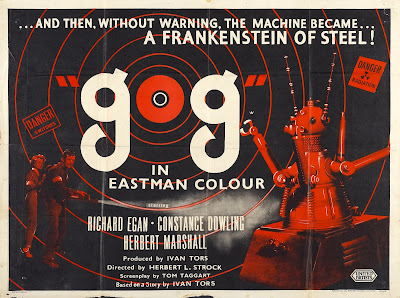
GOG (1954)

A successful combination of sci-fi, murder mystery and espionage thriller. Slow-paced at times but raises issues of relevance for today’s audiences.


Director: Herbert L. Strock
Producer: Ivan Tors
Written by Tom Taggart (screenplay), Ivan Tors (story), Richard G. Taylor (dialogue)
Music: Harry Sukman
Cinematography: Lothrop B. Worth
Editing: Herbert L. Strock
Distributed by United Artists
Running time: 85 min.
Budget: $250,000 (approx.)


Cast


Richard Egan: David Sheppard
Constance Dowling: Joanna Merritt
Herbert Marshall: Dr. Van Ness
John Wengraf: Dr. Zeitman
Phillip Van Zandt: Dr. Pierre Elzevir
Valerie Vernon: Madame Elzevir
Steve Roberts: Major Howard
Byron Kane: Dr. Carter
David Alpert: Dr. Peter Burden
Michael Fox: Dr. Hubertus
William Schallert: Dr. Engle 

Marian Richman: Helen


Preview


Plot


The film, GOG is set in a top-secret government facility under the New Mexico desert where a space station (“Man’s first attempt to conquer space”) is being constructed, OSI (Office of Scientific Investigation) agents from Washington, DC, are called in to investigate mysterious and deadly malfunctions at the facility.


We witness one such occurrence at the start of the film, GOG where a lab monkey is undergoing an experiment in freezing and thawing. After the experiment successfully concludes Dr. Hubertus, the department head, is trapped in the cold chamber when the door to the chamber mysteriously closes and the automated equipment begins its deep cold cycle. Hubertus is frozen solid. Dr. Kirby returns to the cryo lab and discovers the dead and shattered remains of Dr. Hubertus when suddenly the door closes once again and the cryo cycle repeats, killing her as well.


Agent Dr. David Sheppard has been called in by Laboratory supervisor Dr. Van Ness to find the cause of such mysterious deaths among the 150 top scientists at the facility. Together with Joanna Merritt, an OSI agent already stationed at the facility and who is secretly in a romantic relationship with Dr Sheppard, Sheppard determines that the deaths are due to deliberate sabotage of NOVAC (Nuclear Operative Variable Automatic Computer), a central computer which controls all equipment in the underground facility. NOVAC was built in Switzerland and took five years to complete, and Zeitman was the designer.


The important question is, how is the sabotage is being performed? How will they later be able explain the deaths of six scientists, as well as the complex's Chief of Security, Major Howard?


The answer to the mystery is found by Sheppard. It turns out that a powerful radio transmitter and receiver were incorporated into NOVAC during its construction. The unnamed “enemy” have constructed a stealth jet plane that can fly faster than the speed of sound and is made of fiberglass which makes it difficult to be located by radar. As it flies above the facility, ultra-high frequency radio signals are beamed from it, allowing the “enemy” to control NOVAC. The plane can apparently fly over 100.000 feet high and it is observed that “no plane has ever gone that high,” to which Joanna replies, “At least not from this planet.” By controlling NOVAC, the “enemy” also gains control of the two powerful robots at the facility, Gog and Magog, who Dr Zeitman believe will one day “guide rockets into space.”


Who is causing the deaths of crucial personnel at the underground facility? 

Where did such an advanced aircraft come from? 

What nefarious purposes will NOVAC and the robots, Gog & Magog be put to? 

By whom?
 
To what end? 


Points Of Interest


The film, GOG was shot on two sets at Hal Roach Studios, with exteriors done at George AFB, a former Air Force base near Victorville, California. It took just 15 days to shoot all of the footage for the film.


The film at some points does become a bit plodding and tedious such as when security officer Sheppard and his undercover security agent girlfriend Merritt take us on a guided tour of the base. This, together with the long-winded lectures concerning scientific experiments, may have been intended to highlight the positive features of future technologies, but for today’s audiences it seems a bit dated and unimpressive.


What is more interesting are the dangers, fears and insecurities associated with the “new” technological developments depicted in the film; concerns that are relevant even for 21st. Century audiences who are becoming more aware of the almost anonymous destructive potential of military applications of “smart” technologies. There is also the issue of who is really in control when it comes to information and personal privacy in a digital age, particularly when such notions as, “the security of the nation is at stake” are used as justification for employing technology as a means of control and intrusive monitoring of people.


The double-edged sword nature of human technology is apparent when early in the film we see a helicopter cross the desert sky. On board is the pilot, Al and his passenger, Dr. David Sheppard. They are headed for the top secret underground facility. Suddenly the helicopter is buffeted by some force. The pilot explains that the "brain" has taken over the controls and will do the flying, thereby keeping the exact location of the facility secret. They are both being monitored by central control. Instead of being reassuring. it’s all a bit unnerving! NOVAC’s code transmitters will also be in control of the solar mirror which will provide the space station with all its power and its destructive potential as demonstrated by the Elzevirs’. NOVAC will be able to control the space station’s mirrors via code transmitters and as is noted by one of the characters in the film, “It would be a powerful weapon of war.”


Those in the facility have arrived at point where, as Joanna observed, since “the machines took over….we live here like ground hogs.” In addition to an “enemy” possessing intrusive, dangerous and destructive technologies that have led to a fearful, siege-like, underground fortress existence, we learn later that Van Ness has "positive proof of a saboteur” on his staff. Code transmitter devices have been located around the facility. We also learn that unknown even to her boss, Van Ness, Joanna Merritt, as part of a secret mission, has been assigned to the project by the security services that employ Sheppard. At one point, even the illustrious Dr. Zeitman is reprimanded by Sheppard about failing to abide by security regulations (“You’re not above the security of the nation.”)


Fear, suspicion, security concerns: all very apparent even years after the Cold War era with the revelations from Edward Snowden concerning NSA surveillance activities, the US monitoring of the German chancellor Merkel’s phone, as well as Australia’s Signals Directorate secret monitoring of Indonesian Prime Minister, Susilo Bambang Yudhoyono’s and his wife’s phone communications. Unlike the Cold War era animosity between the US and Soviet Union, these modern instances of international mistrust, fuelled by intrusive technological surveillance, are occurring between allies! We won’t even get started on allegations concerning certain Chinese mobile phone and electronic instrument manufacturing companies installing surveillance devices in their products in order to access information from the users of their products. Fancy being able to hack into someone else’s electronic device (computer, Novac, mobile phone, Gog, data base, Magog) and exercise control over it? Who would have thought such a thing could possibly happen back in 1954!


The film, GOG employed an interesting choice of names for the two robots; “Gog” and “Magog.” Initially, this one word title, together with its appearance on the screen at the start, conjures up feelings of timeless and implacable power. The biblical reference to “Gog” and “Magog” (Rev.20:8) involves the names of two nations to be led by Satan in the final battle at Armageddon against the kingdom of God;

“When the thousand years are over, Satan will be released from his prison and will go out to deceive the nations in the four corners of the earth - Gog and Magog - to gather them for battle. In number they are like the sand on the seashore.”

And in Ezekiel 38;

“Son of man, set your face against Gog, of the land of Magog, the chief prince of Meshek and Tubal; prophesy against him and say: ‘This is what the Sovereign Lord says: I am against you, Gog, chief prince of Meshek and Tubal.” 


Perhaps for the purposes of film the “enemy,” the former Soviet Union, was being cast as Satan in the international battle between the forces of “good” and “evil” over the fate of the world.

Other issues raised by the film also have relevance to our era and they include;


Advanced weaponry and security devices: In the film during the segment featuring the electronically controlled sound detector with its tuning forks, we are introduced to the notion of sound waves whose “intensity can kill!" It has been demonstrated in recent times that sound waves of certain frequencies can have quite severe effects on human physiology. Proposals have been made to use sound waves as a form of crowd control during riots and demonstrations and even as a weapon of warfare.


Surveillance & Privacy: The personnel in the underground facility are subject to constant monitoring from various devices such as microphones. In our modern era, we are surrounded by devices that can monitor our actions and movements. Among such ways and means of monitoring individuals include, computer & mobile phone tracking & usage; ATM & credit card transactions; speed cameras: cctv proliferation in major cities; public transport, taxi and department store camera surveillance and more. It is amazing how we have willingly submitted to this intrusion into our personal privacy and right to anonymity. It has become a normal state of affairs for us all and we justify it (rightly or wrongly) in terms of it being necessary to guarantee our overall safety and security.


Perhaps we may reach the stage one day soon when we vow that in another sense, "We'll never be taken by surprise again!" and where we will all resolve to set our faces against the Gogs of our own making and declare, “no more, we are against you, Gog!”


©Chris Christopoulos 2013

Sunday, 14 July 2013

The Magnetic Monster (1953)

Intelligent & well-paced
Plausible-sounding science
Builds up to an excellent climax


Director: Curt Siodmak, Herbert L. Strock
Producer: Ivan Tors, George Van Marter
Writer: Curt Siodmak, Ivan Tors
Running time: 76 minutes
Budget: $105,000 approx.


Cast


Richard Carlson: Dr. Jeffrey Stewart
King Donovan: Dr. Dan Forbes
Jean Byron: Connie Stewart
Harry Ellerbe:  Dr. Allard
Leo Britt: Dr. Benton
Leonard Mudie: Howard Denker
Byron Foulger: Mr. Simon
Michael Fox: Dr. Serny
John Zaremba: Chief Watson
Lee Phelps: City Engineer
Watson Downs: Mayor
Roy Engel: Gen. Behan
Frank Gerstle: Colonel Willis
John Vosper: Captain Dyer
John Dodsworth: Dr. Carthwright
Robert Carson: the Pilot
Donald Kerr:  Nova Scotia Lab Worker 


Trailer


Spoilers follow below......


Office of Scientific Investigation
Official Summary Report
Operation: “Magnetic Monster”

TOP SECRET
EYES ONLY

Background To Investigation

  • On the morning of July 18, 1953, ‘A-Man’ agents, Jeffrey Stewart and Dan Forbes received a report from the power company representative, Chief Watson as part of a DIRECTIVE 149 response, concerning a local hardware store where all of the clocks had stopped at the same time.
  • Investigation revealed that a strong magnetic field had magnetized every metal item in the store and that the source of this was traced to an office above the store.
  • An examination of the room revealed the presence of scientific equipment, as well as a dead body.
  • Detection of radioactivity was confirmed, the cause of which was not immediately apparent.
  • Initial fears centred on the possibility of someone trying to build a small atomic bomb.
  • Further investigation based on information received from a taxi driver and an examination of airport facilities led investigators to an airline flight carrying a research physicist, Dr. Howard Denker and more importantly, to the contents of his suitcase.
  • Dr. Denker had developed signs of radiation sickness due to an artificial radioactive isotope, serranium, which in an experiment he had bombarded with alpha particles for 200 hours. This deadly microscopic product of his experiment was contained in the suitcase in his possession.
  • Dr. Denker died from radiation sickness on board the plane while passing on information to the agents about his creation.

Nature of Emergency

  • Based on the findings fed into the MANIAC system, it was able to deduce that the element would double in size and mass every 11 hours by absorbing energy from its surroundings.
  • The process of transformation released deadly radiation and extremely intense magnetic energy.

Danger Posed: Extreme

  • OSI determined that, if left unchecked, the element would have eventually become large enough to affect the Earth's rotation and cause the planet to spin out of its orbit.

Course Of Action

  • The isotope could not be destroyed or rendered inert by any known means.
  • It was decided there was no option but to use a Canadian experimental power generator then being constructed in a cavern under the ocean. It was intended to use this to bombard the element with as much energy as possible in one surge in the hope that this would neutralize it.  
  • With US and Canadian government cooperation, the isotope was transferred to the new (“Deltatron”) project facility.
  • Dr. Benton, in charge of the project, when shown how much energy would be needed, raised objections and voiced concerns about the safety of the personnel involved.
  • Due to the urgency of the situation, Agent Stewart took it upon his own authority to assume control of the experiment himself despite the risks to his personal safety.
  • Despite Dr. Benton’s efforst to thwart him, Agent Stewart was able to activate the machine and seal the device off from the rest of the underground operation and the project workers. 

Outcome

  • The isotope was successfully stopped.
  • Deltatron was destroyed as a result of the operation.

End Notes:

  • A full report of the above operation will follow at the conclusion of OSI internal investigation of operation, Magnetic Monster.  
  • As part of the report, the following items will be included;
  1. Recommendations of ways & means to meet such future challenges to our existence.
  2. Elimination of opportunities for “lone wolves” to conduct nuclear research.
  3. Managing the dissemination of information to the public via media outlets.
  4. Commendations for those who took part in the success of operation, Magnetic Monster.

End Summary Report


Points of Interest


The main character, Jeffery Stewart narrates the story in a manner similar to a detective-crime genre film complete with lines like, “July 18: The morning quiet,…peaceful…The world seemed safe and good.” We also learn with due seriousness that in order to combat threats that pose a “challenge to our existence,” a new agency has been created, The Office of Scientific Investigation (OSI). As if taken from the pages of the creation of the FBI, the men who work for this agency are known as A men, who perform as “detectives of science,” something akin to J. Edgar Hoover’s G-Men.


In the case of the FBI’s formation, science in the form of forensics became the key weapon in the fight against crime. Science is also the weapon of choice for the OSI in the film, Magnetic Monster. For instance, we see many examples of gadgetry being employed such as an electronic counter to determine that there were “2200 disintegrations per minute” occurring as well as traces of radioactive dust. There were gadgets to monitor the speed and distance of particles and to examine dust particles and fingernail scrapings. An electronic microscope was used to examine the element whereby the investigators could see that it was “adding new structure to the old,” that “mass is forming into supposedly empty space” and that with this tool of science they were “witnessing the secret of creation.”


The silence that followed the last statement above was laden with profound implications. At what point does science cross over into areas where some people believe it should not and cannot cross. The name given to this new breed of investigators is A-Men which as we are told by the narrator, “sounds like the final word of a prayer.” Perhaps it is no wonder that people sometimes worry that materialistic science seems to assume the mantle of a new kind of religion. After all, the world and what seems to be inexplicable appears to be able to be explained by the new religion of science and its own version of the priesthood. In the face of the hysterical and panicked reactions of those in the hardware store, we have the calm and methodical resort to paper, tacks, fishing poles and Geiger counters to locate the epicentre of magnetic force in the store. In days gone by people would have been reassured by the priesthood that certain inexplicable occurrences were part of God’s will or the result of the Devil’s work, often resulting in the immolation of innocent people to rectify the perceived problems.


In the area of science, there is a certain unease of the times being reflected in the film, Magnetic Monster. After all, it was scientific research that produced an element that even in the initial stages resulted in the production of radiation that was “strong enough to kill us or wipe out a few city blocks.” Whether done independently or not, science had created something new that “turned out to be unstable,” that was “monstrous” and capable of “reaching out with invisible fingers” to kill! If only such research was removed from the hands of “lone wolves” and placed in the all-knowing secure embrace of government scientific centralised control!-at least as implied in the film. Similarly, once upon a time all knowledge about the world remained securely within the province of the church and its priesthood. “Lone wolves” and the threat posed by the spreading fingers of their devil’s work were dealt with using the tried and tested tools of the time.


The unease of the times is further highlighted by the fact that the element created by Dr. Denker appears to be as Forbes exclaims, “a live thing!” If it is not “fed” it draws on available energy and causes an implosion. Even the plan to destroy the element involves an attempt to “overfeed it until it bursts.” Instead of the usual monsters from space, the ocean depths or from under the ice, we have an impersonal, apparently indestructible and unseen monster. For many, the products of science and technology seem to take on a life of their own, growing more powerful, demanding more and more from us, reaching out and infiltrating all aspects of our lives and even threatening our own existence.


In Magnetic Monster and many other similar films of the time, it seems as if it is felt that people’s fears and concerns can be assuaged by controlling how much and what type of information they are to be exposed to. In the film, the city is put on alert but people are informed via radio broadcasts only that the authorities are “conducting a test.” Even today we find ourselves grappling with issues of freedom of information and are left wondering how much information is being withheld from the public about matters that effect all of us; how truthful the information is that we are being presented with and whether or not matters of “national security” should override our need or right to know the truth. Such matters are curently being put to the test in relation to the controversial treatment of organisations like Wikileaks and individuals such as Julian Assange, Edward Snowden and Bradley Manning. For some people and governments, they are seen as traitors, while for others they are simply upholding the principles of free speech and the right to know, as well as performing the kind of role that the world’s media ought to be performing. One can only hope that we don’t have recourse to the kind of witch hunts that were prevalent at the time of the making of Magnetic Monster.

Magnetic Monster was shot in eleven days. Footage from a clip of an atom smasher from the 1934 German film, Gold was used in the scene of the Nova Scotia Deltatron. It seems to have been quite a seamless fusion of the footage in the film. The "M.A.N.I.A.C." computer with the “cathode ray memory unit” consisted of footage featuring a computer being developed at the University of California in Los Angeles. Glad to see scientists and technicians (film makers?) have a sense of humour and irony!


©Chris Christopoulos 2013